When you think of microbial growth, what colors do you imagine?
I’m guessing it is the green of mildew, the brown of rot, the white of sore throat pustules.
I imagine it is not the cerulean of the soil microbe that makes our antibiotics, the cotton candy pink microbe that produces life-saving statins, the orange fungus that helps plants stay healthy, the midnight black of the fungus that makes vitamins for us, or the unctuous white of the microbe that makes sourdough taste so tart and lovely.
The microbes around us naturally produce a rainbow of colors. To display this with some whimsy, I gave a set of 48 Crayola(R) brand crayons a make-over, relabeling them with the microbes that create this biological palette.
Below are the 48 microbes, including the fungi, bacteria, and archaea with a bit of information on how we interact with them, and links to their natural colors. This is just a glimpse into the microbes that make our world colorful.
Welcome to the colors of your biological cosmos.
Images of the Microbe Crayon Project
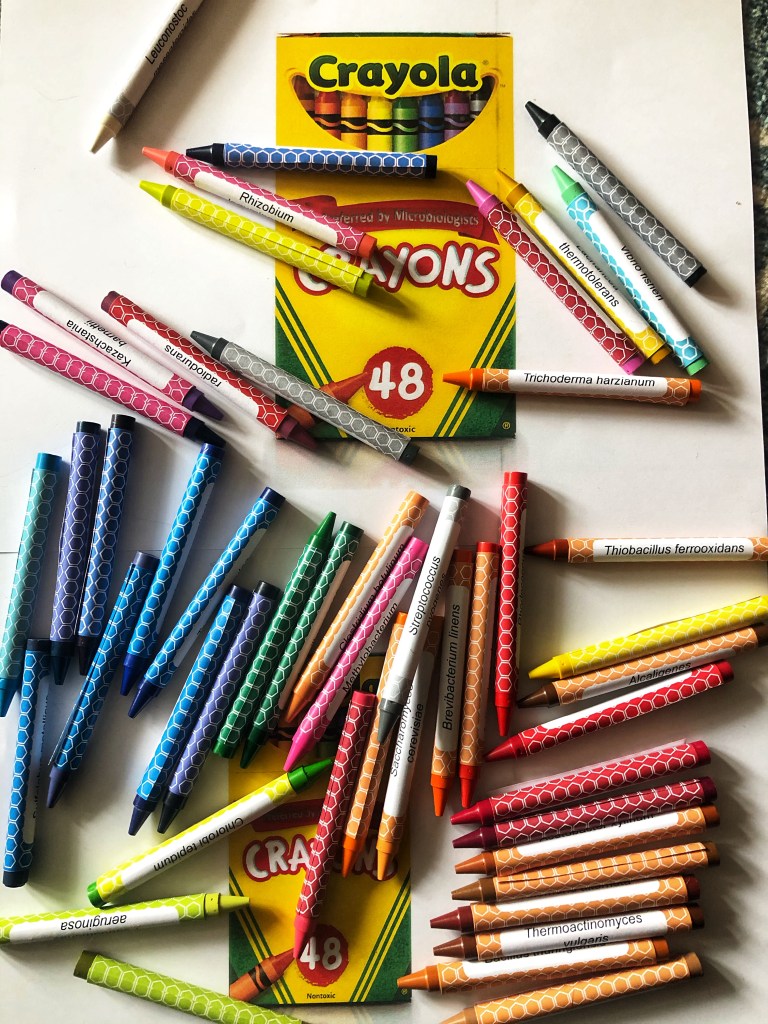

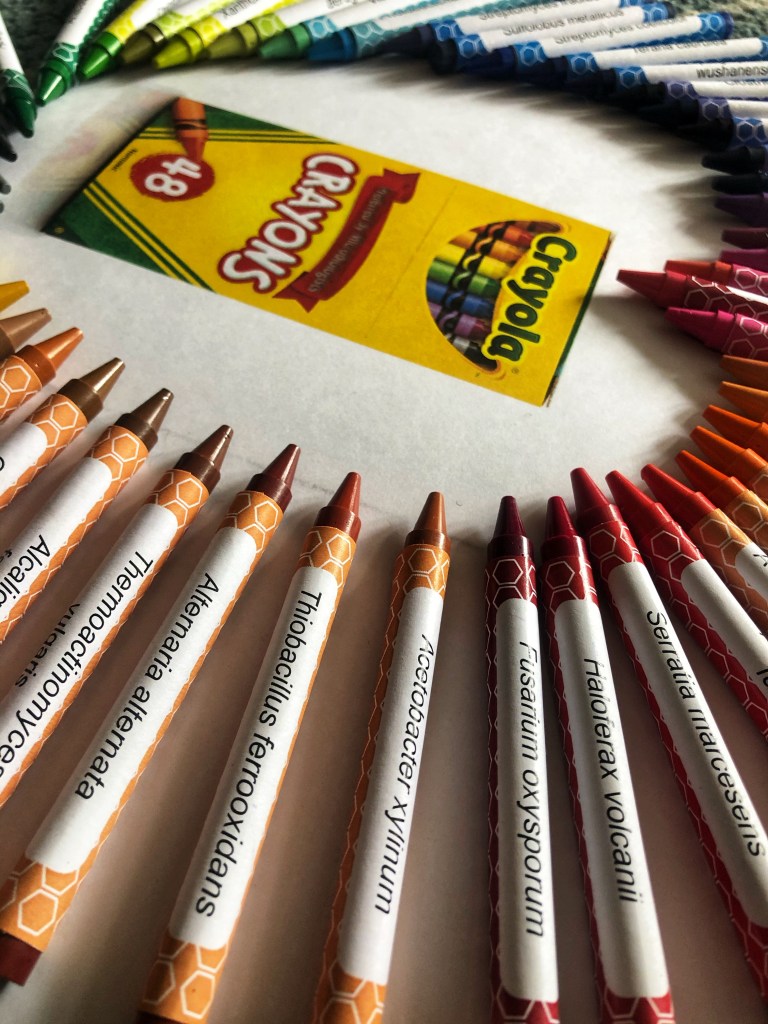





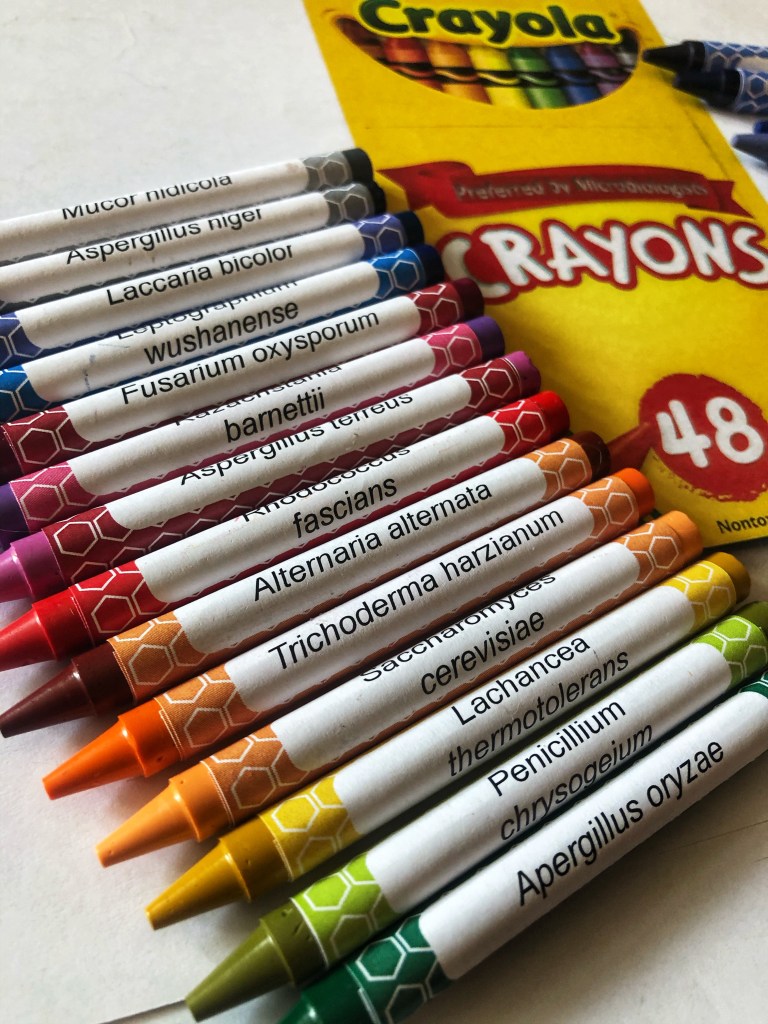

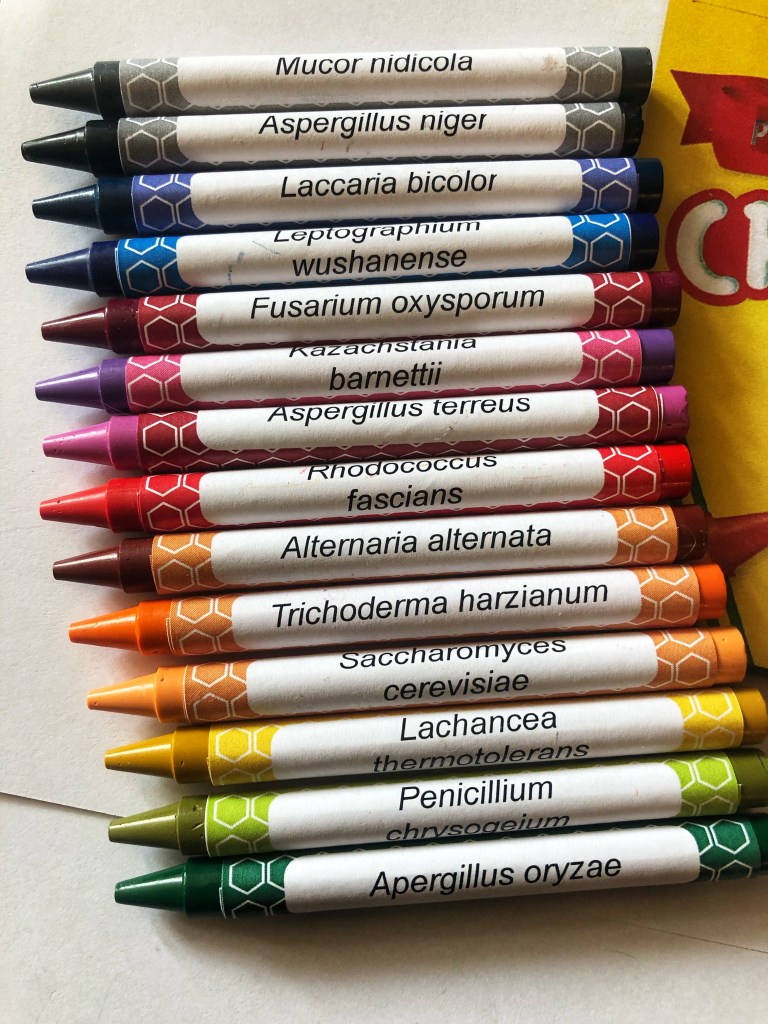

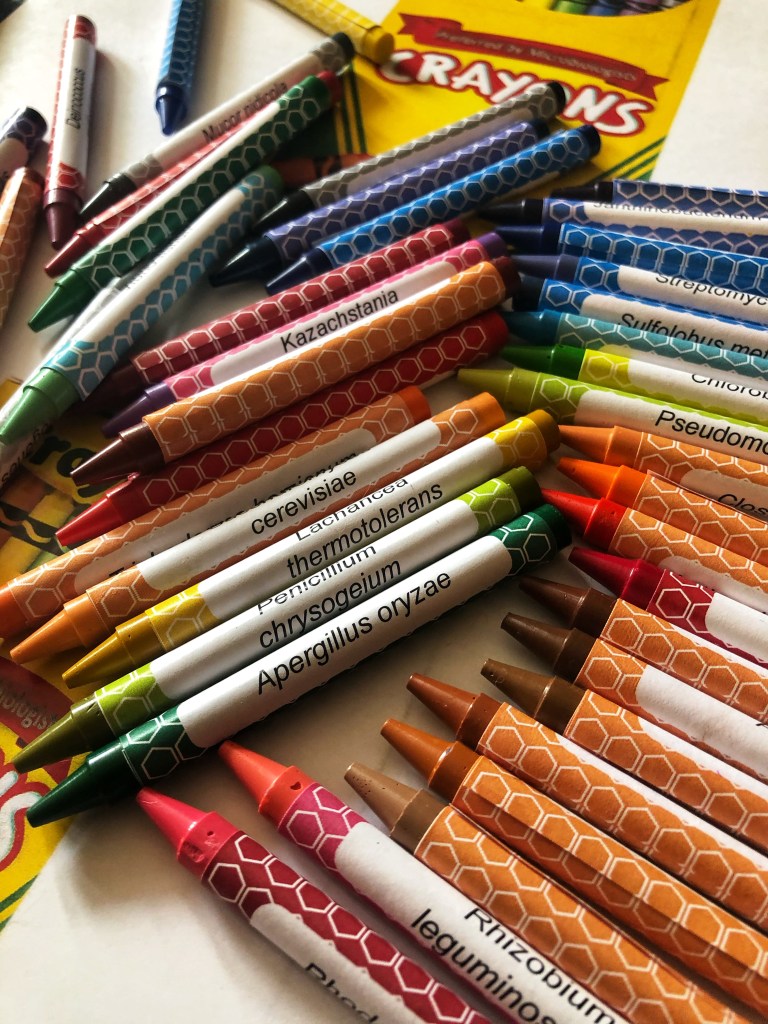

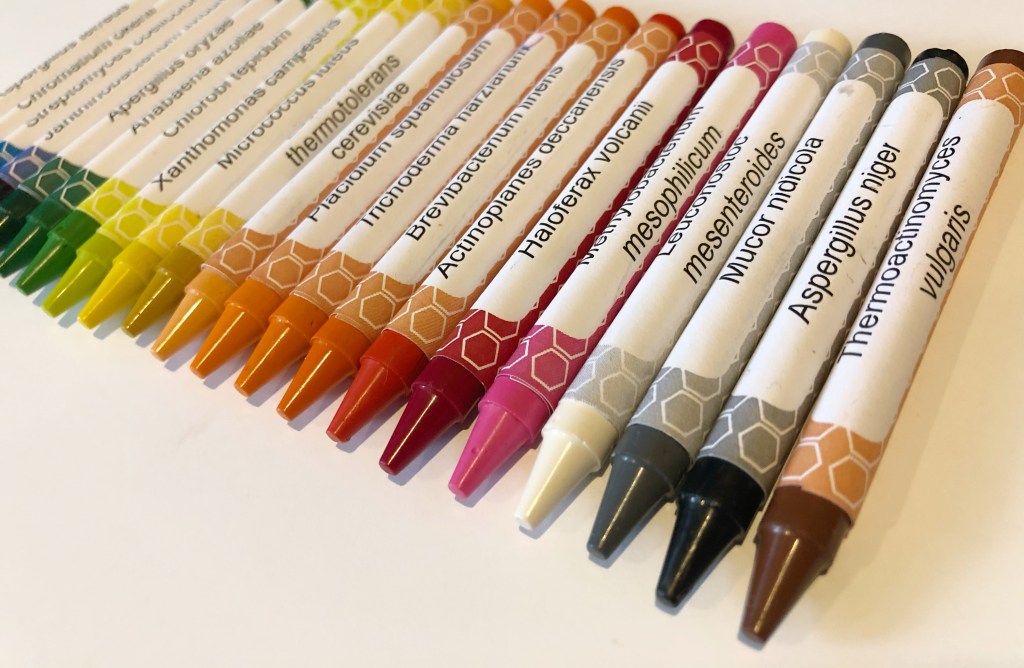
Some of the microbes producing their natural pigments

Aspergillus green 
Brevibacterium orange 
Rhodotorula pink
Explore each crayon microbe in more detail:
- Aspergillus niger: a fungus that makes black spores. It produces citric acid for us, which we use as a food preservative.
- Trichoderma harzianum: a fungus that is added to plants to help protect the plants from fungal infections. When growing in the lab this fungus naturally produces a vibrant orange color.
- Pseudomonas aeruginosa: a bacterium that is often associated with secondary infections of the upper respiratory system. It produces a yellow-green ‘goo’ that helps it gather iron, which it needs to survive.
- Penicillium chrysogeium: a fungus that makes the antibiotic Penicillin.
- Photobacterium leiognathi: a bioluminescent bacterium that lives inside of ponyfish and helps them avoid predators.
- Lachance thermotolerans: a yeast that we found in wasps and bumblebees that is now used to create fast, scalable monoculture sour beers with honey and floral aromas.
- Fusarium oxysporum: a fungus that causes plant diseases. It is known for producing vibrant pink pigments when grown on nutrients in a petri dish.
- Serratia marcescens: a bacterium that can be found in our bathroom, or throughout the environment. It produces so much red pigment, it is a favorite of bioartists who use microbes to paint pictures.
- Bacillus licheniformis: a bacterium found on bird feathers that produces an enzyme-a molecule- that is in Tide cold water detergent. It allows us to wash clothing at colder temperatures, thereby reducing the amount of energy we use per wash by ~50%.
- Chromobacterium violaceum: a bacterium found in many rivers and streams, it produces a purple compound that has been used to dye textiles.
- Vibrio fisheri: a marine bacterium that is bioluminescent. It can live inside bobtail squid and help them evade predators.
- Methylobacterium mesophilicum: a bacterium that can be found in the pink ooze that accumulates in our shower or toilets. It is found in nature living on plants where it can feed on molecules that are too hard for many other creatures to feast on.
- Micrococcus luteus: a bacterium that lives naturally on our skin, and may be the reason gym bags smell so bad. In the lab it naturally produces a bright yellow pigment and may be a future source of a living sun screen.
- Streptomyces fradiae: a bacterium in the soil that makes the smell of fresh turned earth (geosmin). It also produces the antibiotic fosfomycin for us, this is an important antibiotic to fight of urinary tract infections.
- Rhizobium leguminosarum: this bacterium lives in the nodules of clover–and other legume–roots. The nodules turn pink as the plant creates a space for the bacterium to grow, in return for getting the nitrogen fertilizer produced by the bacterium.
- Streptococcus pyogenes: the bacterium that causes strep throat. By investigating the genome–genetic sequence– of this bacterium, scientists found a way to create the tool CRISPR-Cas9. This is a set of molecular scissors that is used to help scientists genetically engineer any organism they want.
- Rhodotorula glutinis: This yeast produces pink pigments that are carotenoids. This is the same molecule that gives flamingos their characteristic color.
- Actinoplanes deccanensis: this bacterium lives in the soil and produces vibrant orange colors when grown on nutrients in a petri plate. It can produce antibiotics for us.
- Leuconostoc mesenteroides: this bacterium is a lactic acid bacteria that helps make sourdough bread taste tart. It is involved in many of our fermented foods.
- Alternaria alternata: this fungus is often found floating through the air. It is one of the major causes of fungal allergies.
- Mucor nidicola: this fungus was found living in the nest of a paper wasp. Like other species related to it, it produces oils such as DHA which can be used for infant formula supplements.
- Glomus aggregatum: a fungus that lives inside the roots of many plants and helps them take in nutrients.
- Kazachstania barnettii: a pink yeast in some sourdough starters that helps give rise to the lovely bread.
- Acetobacter xylinum: this bacterium produces nanocellulose which is used to make face masks and wound covers that are extra-hydrating. This is also one of the microbes that makes the SCOBY in kombucha.
- Brevibacterium linens: a microbe that both makes our feet stink and our cheese smell delightful. Many orange rind cheeses are orange in part due to this microbe.
- Xanthomonas campestris: this bacterium is a deadly pathogen for plants, but in the lab it is used to make Xantham Gum, a natural food additive that is used in everything from cosmetics, to tooth paste, to Orbitz drinks.
- Janthinobacterium lividum: this bacterium makes a vibrant violet pigment. The pigment has anti-fungal capabilities and has been shown to be a promising cure for the deadly chytrid fungus which is wiping out the world’s amphibians.
- Deinococcus radiodurans: microbes can live nearly everywhere, and this microbe proves that. Out of all creatures on the planet, this species is one of the best at surviving radiation.
- Thermoactinomyces vulgaris: This heat loving bacterium is partially responsible for increasing the heat in compost. Some flightless birds in Australia make compost nests to help incubate their eggs.
- Clostridium botulinum: This bacterium can cause the deadly botulism disease in humans, but in the lab it is the origin of the muscle paralytic Botox. Botox is used to treat sweating, headaches, and for cosmetic purposes.
- Streptomyces coelicolor: this soil bacterium produces the vibrant blue antibiotic Actinomycin D. Some bioartists even use this pigment to paint with.
- Aspergillus terreus: This soil fungus can often be found clinging to your shoes, or hanging out in our house dust. It is the one of the producers of statins–the cholesterol-lowering medications that save many people’s lives ever year.
- Haloferax volcanii: an archaea that can live in extremely salty environments. It is also one of the microbes that helped scientists discover the gene-editing tool, CRISPR.
- Bacillus thuringiensis: a bacterium that can be found in the soil. This species makes the Bt toxin, a toxin which is non-toxic for humans, but when added to plants helps reduce the number of insects that feed. It is used in many organic farming practices.
- Placidium squamulosum: a lichen (community of fungi and bacteria) that forms soil crusts in the desert and helps protect the soil.
- Leptographium wushanense: This fungus is associated with bark beetles. It helps the beetles survive, but creates a blue stain in the tree associated with the blue stain disease.
- Thiobacillus ferrooxidans: This bacterium is found associated with the natural chemical cycle of iron. It may be useful for bioremediation, or the clean-up of toxic waste sites.
- Terana caerulea: This is a fungus that is known as the “cobalt rust fungus.” It can be seen as giant bright blue patches on logs. It helps with decomposition.
- Alcaligenese faecalis: This bacterium is found through natural environments and may be of use in helping clean up oil spills.
- Anabaena azollae: this photosynthetic cyanobacteria converts light into sugars. It is typically a green color.
- Chlorobi tepidum: this is a green sulfur bacteria that helps with the natural cycling of sulfur.
- Sulfolobus metallicus: This archaea can live in hot and acidic conditions. It is used to help us mine copper.
- Rhodococcus fascians: this is a plant pathogen that causes leafy gall syndrome.
- Saccharomyces cerevisiae: this yeast is used to help us make beer, scotch, donuts, bread, wine, and even coffee. It is naturally found associated with insects, plant nectar, fruit, and tree sap.
- Laccaria bicolor: This is a macroscopic fungus–where the fruiting bodies are seen as mushrooms. It is a fungus that is involved in helping plants gain access to more nutrients and resources.
- Clostridium isatidis: This bacterium is one of many that help convert plant dye into the natural indigo dye that has been used for centuries.
- Aspergillus oryzae: This fungus is used to help make sake. The fungus breaks down the sugars in rice, where yeast are then added to feed on the sugars and produce the alcohol.
- Chromatium okenii: This purple sulfur bacteria can naturally be found making decomposing plant material purply-pink in estuaries.

Sources of bacterial images in the composite above:
· https://en.wikipedia.org/wiki/Serratia_marcescens
· http://faculty.ccbcmd.edu/courses/bio141/labmanua/lab3/cnaml.html
· https://www.ccos.ch/knowledge_base/ccos_strain_info/methylobacteria
· http://biohackacademy. github.io/bha5/organisms/janthinobacterium-lividum/
· https://www.researchgate.net/figure/Streptomyces-coelicolor-klmp33-on-starch-casein-agar_fig1_236782488
· https://www.dsmz.de/catalogues/details/culture/DSM-20307.html
· http://faculty.ccbcmd.edu/courses/bio141/labmanua/lab3/pasollight.html
· http://juenvmicrobiotech.co.in/cyanobacteria-of-the-sundarbans/
Open Source Guide & Activities
As always, every effort was made to make this project as open source as possible to facilitate microbial science communication. The list of species is provided (above). The The original template was provided by handmadecharlotte.com. The full guide is available at github. More information on these microbes–and many others–can be found at microbe wiki, or by following me at @AnneAMadden on twitter.
**Disclaimer: This is version 1.0. Many of the color-matches could be improved (and some spelling errors caught)! Can you see where I may have switched a few crayons (by accident!) when putting on the labels?
Microbe Crayon Inspiration
As a microbiologist who wrangles microbes from environmental sources, color has always been an important part of my research story. I would look for the characteristic orange of the microbe growing on a petri plate to help me find those that lead to the discovery of novel antibiotics. It was the profuse white and grey fluff of certain fungi in graduate school that made them endearing, and helped me discover and name a new species.
I also have always found the many microbial pigments to be inspiring aesthetically. We often refer to colors by what we see in nature that produces those colors. We grow up knowing about “flamingo pink,” “rose red,” “dandelion yellow.” Yet it was our ancient microbial cousins who first discovered how to make these natural pigments. Sadly we do not grow up learning about “Methylobacterium pink,” “Serratia red,” or “Micrococcus yellow.” Yet it was these microbes who helped the babylonians make indigo dye and we still rely on many of these microbes to produce pigments today. So often microbes can produce vibrant pigments in more sustainable and humane ways that current practices.
Gaining further inspiration from the book “The Secret Life of Color” and education projects in chemistry related to crayons, I wanted to share the colors of the microbiological cosmos in a whimsical and accessible way. Coloring with crayons was a soothing part of my childhood. What could be a better way of introducing audiences to some of the beauty of the microbial world?
And as with many things in nature, the beauty is both aesthetic and functional. Many of these vibrant microbes are also busy making our lives better–from those that produce our antibiotics to those that help keep our crops healthy. I hope that this project and others like it inspires generations to think about all the microbial discoveries that await if we just dig a little bit deeper into the microbial world.
(c) Anne A. Madden 2020 (CC BY-NC-SA 3.0 US) Attribution-NonCommercial-ShareAlike 3.0 United States
 Anne A. Madden, Ph.D
